

AI product development is the process of designing, building, and launching software products that use artificial intelligence, either as a tool that speeds up how you build, or as a feature that makes what you build smarter. For business owners, understanding the difference between those two things is where clarity begins.
This guide explains what AI product development actually means in practice, what it costs, where most projects fail, and what to do before you start building.
What AI product development means in practice
There are two ways teams use AI in product development today.
AI as a development tool
Developers use tools like Claude Code, Cursor or GitHub Copilot to write code faster, catch bugs, and automate repetitive parts of the build. The end user never sees the AI. It just means the product gets built more quickly. This is sometimes called AI-assisted development or AI-powered software development.
AI as a product feature
Artificial intelligence becomes part of what users experience directly. A chatbot that answers questions. A recommendation engine that suggests what to buy next. A dashboard that surfaces anomalies in your data before a human would notice. The AI does something visible and valuable inside the product.
Most conversations about AI product development mix these two things. For a business owner, they require very different decisions and very different investments.
Why most AI product development projects fail
The businesses that get good results from AI products are not the ones that moved fastest. They are the ones that started with a clear problem.
AI tools like Lovable, Bolt, Cursor, and Claude Code have made it possible to ship a working prototype in an afternoon. That is genuinely exciting. But "working" and "production-ready" are not the same thing.
The numbers are a clear story. Studies show that 85% of AI initiatives never make it to production due to poor scaling or architectural problems. 45% of internal AI applications contain critical security gaps that expose sensitive data during deployment. In our experience the gap between a demo and a real product accounts for 40 to 60% of total engineering effort, including security hardening, error handling, edge cases, deployment pipelines, and monitoring that most founders do not budget for because nobody warned them it existed.
The issue is not that AI writes bad code. AI optimizes for "does it run?" Not "is it safe, scalable, and maintainable?" Those are engineering questions that require human judgment. They do not disappear because the code was generated quickly.

Three things AI can realistically do for your product
Automate repetitive decisions
If your team makes the same judgment call dozens of times a day based on consistent rules and data, that is a candidate for automation. Approvals, categorization, routing, flagging. AI handles these at scale without adding headcount.
Personalize the experience
If you have enough user data, AI can tailor what each person sees or is offered in real time. Recommendation engines, adaptive interfaces, smart search. The value is in relevance at scale.
Surface patterns in your data
AI finds signals in large datasets that humans would miss or take too long to find manually. Churn risk, demand forecasting, quality anomalies. The output is insight that drives better decisions across the business.
Most businesses do not need all three. Most businesses need one, done well.
What separates AI products that work from ones that do not
The right model for AI product development combines AI speed with senior engineer oversight.
AI generates. Engineers review. Nothing reaches production without human approval.
That combination is what closes the gap between a prototype and a product your customers can actually trust. When you use AI tools on your own, you are both generating the code and checking it. Data shows that only 23% of developers consistently review AI-generated code for security before shipping (And we are part of them.) The roles need to be separated.
The businesses winning with AI are not the ones that moved fastest. They are the ones that moved deliberately: starting with a clear problem, building on scalable infrastructure, treating security as a design input, and doing the discovery work before writing a single line of code.

How much does AI product development cost?
Traditional agency MVP: $50,000 to $150,000. Six-month timelines. Most founders cannot justify this for a first product.
Hiring a senior developer: $10,000 to $30,000 per month. High cost, slow ramp-up, no guarantee of AI expertise.
The smarter path combines AI speed with engineering oversight at a fraction of those costs, delivered in weeks, not months.
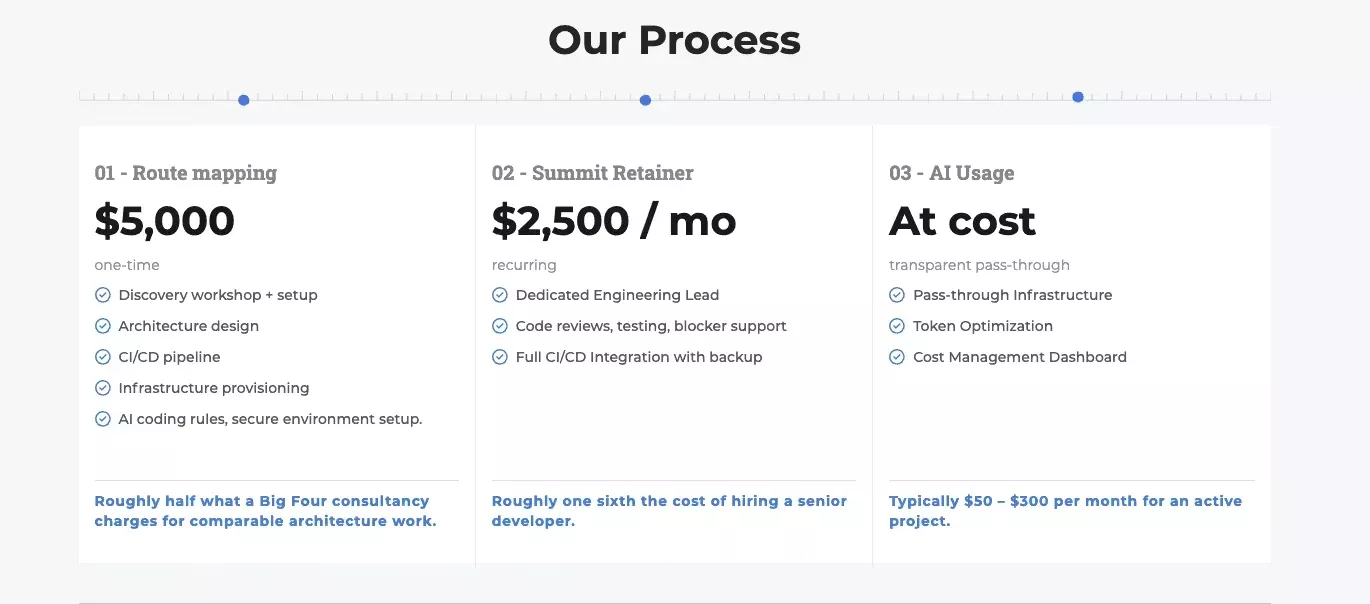
At Rocksoft, AI product development starts with Route Mapping, a one-time $5,000 session that covers architecture design, CI/CD pipeline setup, infrastructure provisioning, and a secure AI coding environment. From there, a dedicated engineering lead reviews every feature before it goes live.
Before you start building
If you are a business owner thinking about AI product development, start with one question: is there a decision or task in my business that happens repeatedly, at scale, and that better information or automation would meaningfully improve?
If yes, that is worth exploring properly. Not by starting to build, but by defining the problem, validating the data, mapping the workflow, and making sure what you are building connects to a real business outcome.
Skip that work, and you are not using AI as a tool. You are using it as a risk multiplier.

Frequently asked questions
What is the difference between AI product development and regular software development?
Regular software follows fixed rules. AI-powered products learn from data and adapt over time. The development process requires additional steps: data validation, model selection or integration, testing for edge cases and bias, and ongoing monitoring after launch.
Can I use vibe coding tools to build a production-ready AI product?
You can build a working prototype quickly with tools like Claude Code, Lovable or Cursor. But "working" and "production-ready" are different things. In 2025 and 2026, documented incidents from AI-generated code included deleted databases, 1.5 million exposed API keys, and platform-wide breaches, all from code that passed testing. Production-ready AI products require human engineering review, security hardening, and proper architecture before they go live.
How long does AI product development take?
A focused MVP with clear scope can be production-ready in weeks, not months. The timeline depends on scope definition, data readiness, integration complexity, and how early architectural decisions are made. Projects that skip discovery tend to take twice as long and cost significantly more.
What is the first step in AI product development?
Define the problem before you define the solution. The most common failure in AI product development is building something technically impressive that does not solve a real business problem. A structured Route Mapping process, covering architecture design, data validation, and success metrics, is the highest-leverage first step before any code gets written.
What industries benefit most from AI product development?
Any industry where decisions are made repeatedly at scale, or where large amounts of data go underused. In practice, the strongest results come from logistics and field operations (route optimization, real-time tracking), professional services (automating document review, client reporting), e-commerce (personalization, demand forecasting), and SaaS businesses adding intelligent features to existing products. The common thread is not the industry. It is having a clear, specific problem and the data to address it.
If you are ready to build an AI product the right way - See how we work.