
Picture this:
Your product is live. Revenue is coming in. The team is growing.
Maybe you're onboarding your first serious client. Maybe someone in a meeting asked about your security practices — and you didn't love your own answer.
Somewhere between the growth metrics and the next sprint, a question surfaces:
"Should I get a code audit done? And how bad is this going to be for my wallet?"
For most business owners, this question shows up at the worst possible time — right when things are finally moving. It feels like a basic question, but it turns out to be surprisingly hard to answer clearly.
So let's walk through it.
Back when the answer was simple (and expensive)
Not that long ago, the path to a code audit was predictable. You'd reach out to a consultancy. They'd send in a senior developer — sometimes a whole team — and spend a few weeks going through your codebase like a very methodical detective.
A Reddit thread from r/cybersecurity (link) broke it down clearly:

So you were looking at $5,000 to $15,000 for the first pass. Then fixes. Then re-verification. Add the 20–40% buffer and you start to understand why a lot of founders quietly skipped it and hoped for the best.
Then AI arrived and made everything confusing
With tools like Cursor, Bolt, and Base44, founders who couldn't tell a JWT from a jigsaw puzzle were suddenly shipping full apps in an afternoon. The vibe-coding era had arrived — and with it, a wave of products built fast, under pressure, without much thought for what happens next.
Naturally, people started asking: "Can't I just ask the AI to audit it?"
The answer is yes — sort of.
AI tools are surprisingly good at catching surface-level issues: hardcoded credentials, outdated dependencies, obvious database misconfigurations. If you want a quick check before launch, asking your AI assistant to "review this for security issues" can genuinely help.
But there's a catch that doesn't get talked about enough.
AI can't audit its own blind spots
If your app was built by AI, asking that same AI to audit it is a bit like handing your essay to the person who wrote it and asking them to check for mistakes. They'll catch the typos. They won't question whether the whole argument makes sense.
This came up directly in a Reddit thread that Edwin, our colleague, posted in r/AskVibecoders (link). He asked Reddit users what they think about how much such an audit should cost.
Here's one of the replies:
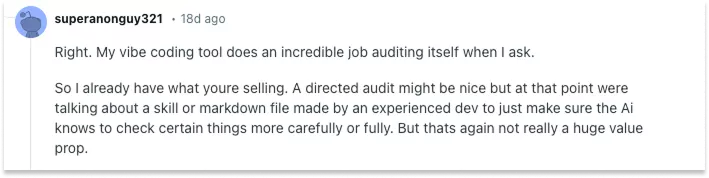
That confidence is exactly the problem.
The real issues tend to surface later — when you have real users and real money at stake. Login flows that break under load. Databases with overly permissive rules. Third-party integrations that were never properly validated. Architectural decisions that looked fine at MVP stage but quietly accumulate risk as the product scales.
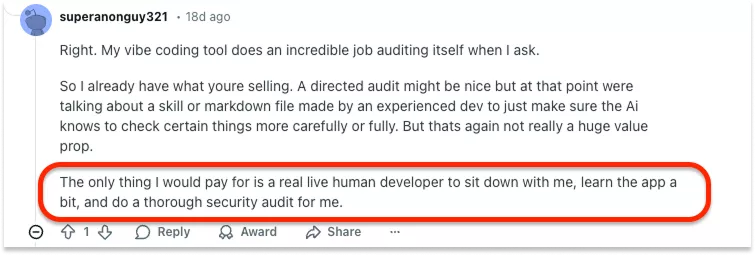
Luckily, it wasn't the end of the comment by superanonguy321:
That might feel familiar if you've ever worked with a freelance developer who moved on and left no documentation.
That's a feeling we've heard often. If you've been in that situation — where code exists but nobody fully understands it — this post might resonate.
Where the pricing sits in 2026
The market has split into a few distinct tiers. Which one you need depends on where your product is right now — not where you want it to be.
AI-assisted self-review costs you nothing but time. It's a reasonable first pass, good for catching obvious issues before you bring in a human. Just don't mistake it for a real audit.
A freelance developer review typically runs $500–$3,000. You get a skilled pair of human eyes on what matters most: authentication, API security, database setup, third-party integrations. For an early-stage product without much complexity, this is often exactly the right level.
A full specialist audit from a consultancy brings you back into the $5,000–$15,000+ range. Comprehensive review, written report, and re-verification after fixes. If you're handling payments, personal data, or onboarding enterprise clients, this level tends to just come with the territory.
The price goes up with complexity, tight timelines, and how much formal documentation you need at the end.
What the audit is actually protecting
Here's the framing that matters.
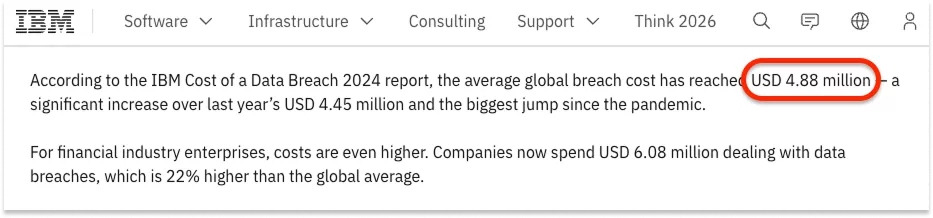
A security breach for a mid-sized company costs an average of $4.88 million in damages, downtime, and recovery, according to IBM's 2024 Cost of a Data Breach report. Even a modest incident — a data leak, a corrupted database, a payment flow that fails under load — can cost tens of thousands in lost revenue, emergency developer time, and customer trust you can't buy back.
One hour of emergency developer time after a production incident typically runs $200–$500. A code audit is insurance with a fixed scope and a known price.
That's exactly why we built a structured workflow around it. Most audits are expensive because every engagement starts from scratch. Ours don't. We have a repeatable process that lets a senior engineer go deep quickly — which is why we can offer this at a fraction of the traditional consultancy rate.
Rocksoft Code Audit packages
We offer two clearly scoped packages — no open-ended timelines, no "contact us for a quote."
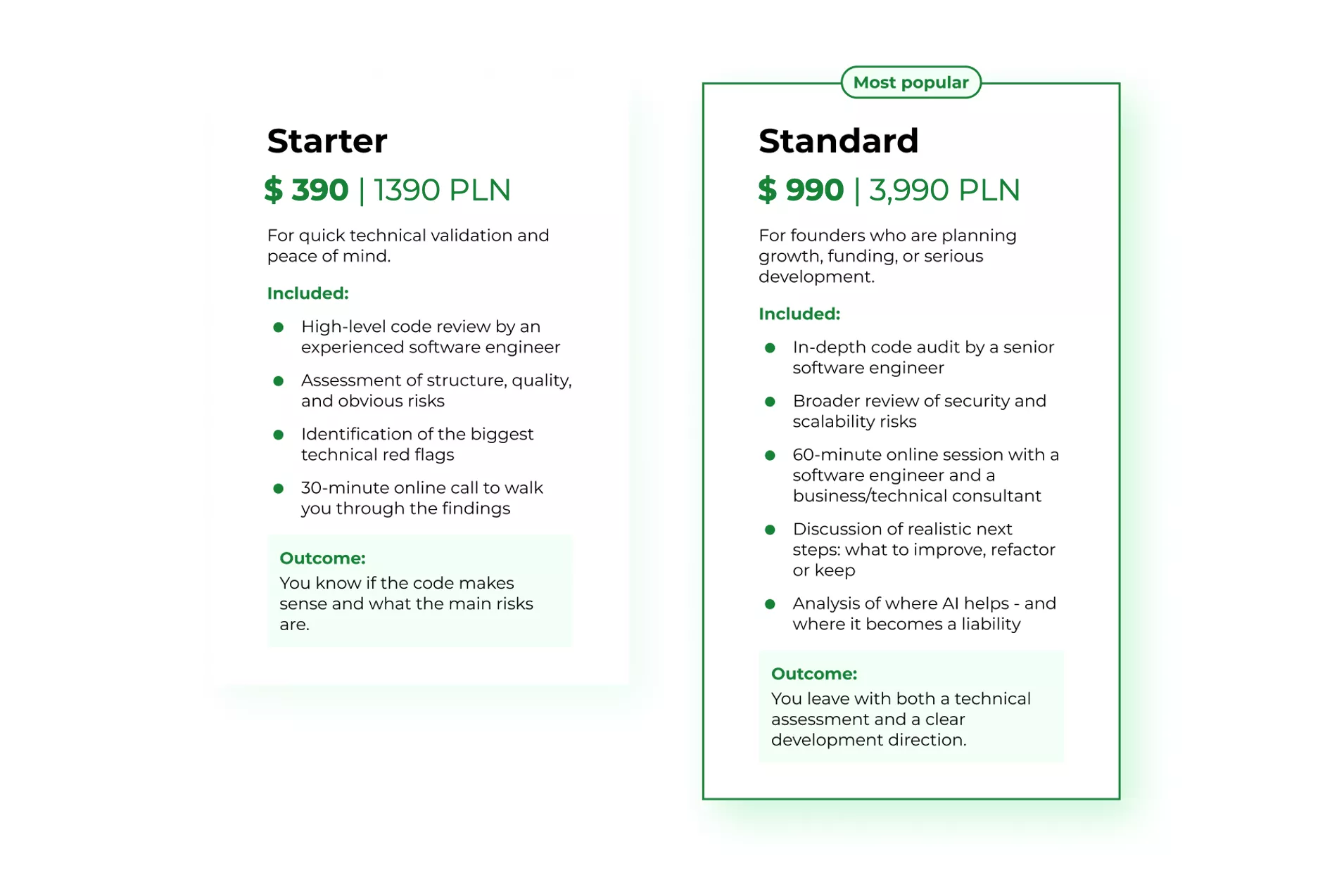
Starter — $390 / 1,390 PLN
A senior engineer reviews your codebase, identifies the biggest technical risks, and walks you through the findings in a 30-minute call. You leave knowing whether your code makes sense and what the main risks are.
For context: one hour of emergency developer time after a breach typically costs more than this entire package.
Standard — $990 / 3,990 PLN
An in-depth audit covering security, scalability, and your development direction — including where AI-generated code helps and where it quietly becomes a liability. Includes a 60-minute session with both a software engineer and a business consultant. You leave with a technical assessment and a clear development direction.
This is the level that gives you something concrete to stand behind when a new client asks about your security practices.
No hidden fees. No scope creep. No pressure to continue.
The real question behind the question
Most business owners asking about price aren't really asking about price.
They're asking: is my product solid enough to keep growing on?
A code audit is a moment where someone with no emotional attachment to what you've built takes an honest look and tells you what's actually there. Sometimes the findings are reassuring. Sometimes they're uncomfortable. Either way, you come out knowing where you stand — before your users find the problem for you.
If you're curious about how to build with AI more safely from the start, this post on vibe-coding done correctly is worth reading first.
And if you want to talk through whether an audit makes sense for your specific situation — no jargon, no oversized proposals — we're easy to reach.