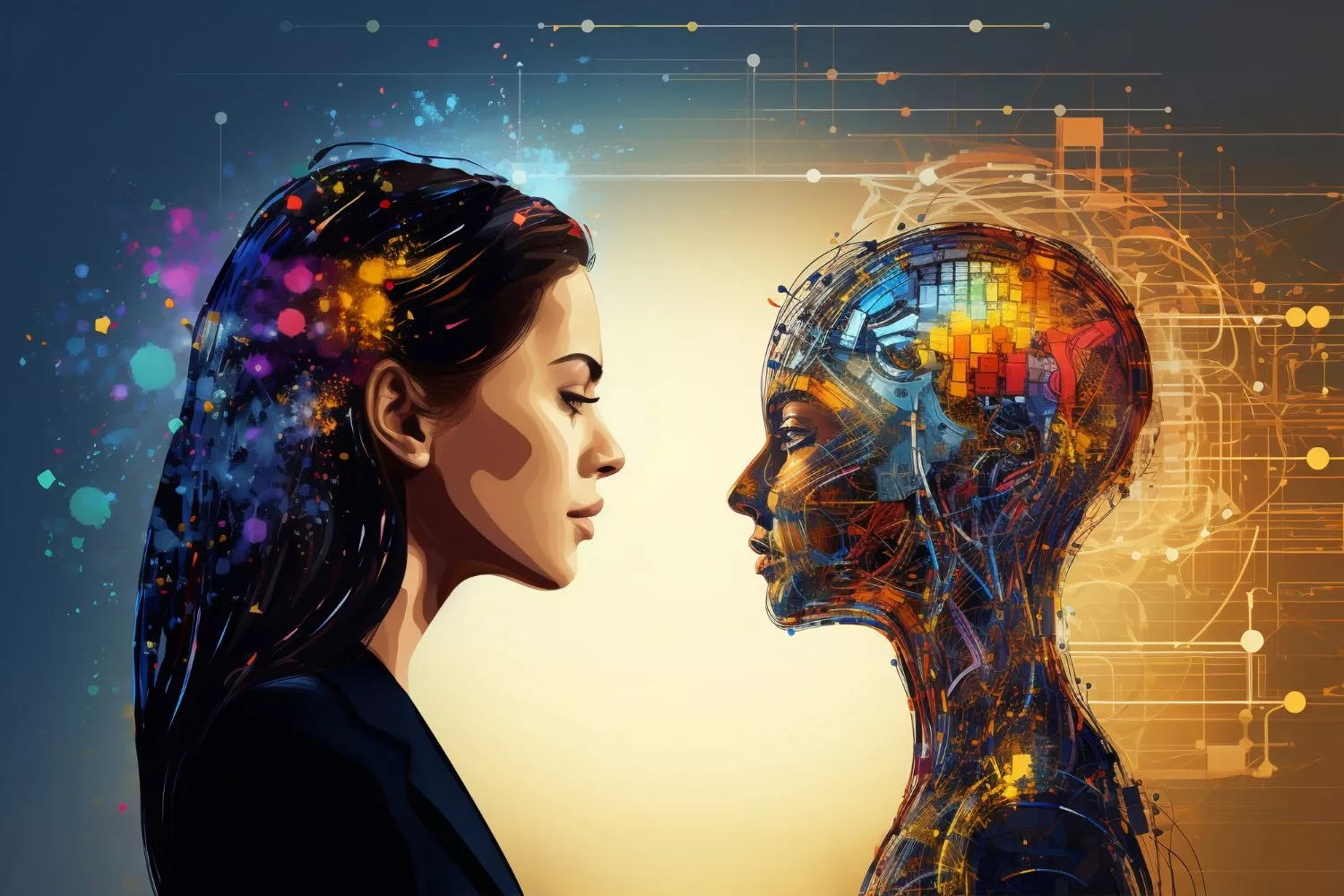

AI models are extremely powerful, and many people say "AI will replace us." However, this article aims to highlight the power of the human mind and explain why we should not underestimate it.
This article is written in the form of a comparison of AI vs human intelligence. If you expect either of these two to win this comparison, you might be disappointed. My view is based on my research and experience as a business owner and developer.
Before we go to my arguments and observations, the essential thing is to understand what AI is and how it works. If you already know the basics, feel free to skip ahead.
What is Artificial intelligence and how does it work?
Artificial Intelligence (AI)
Artificial Intelligence (AI) is a broad term for software that performs tasks we usually associate with human thinking: recognizing patterns, making predictions, generating text, or analyzing data. Think of it as a high-powered accelerator for your business. It can process mountains of information in seconds, far faster than any person could, but it lacks a steering wheel. It lacks gut feelings, lived experience, and common sense. It follows the patterns it was taught, nothing more.
Large Language Models (LLMs)
A Large Language Model (LLM) is a type of AI that powers tools like ChatGPT, Claude or Gemini. The "large" part refers to scale. These models have "read" a significant portion of the written internet, books, and code. The "language model" part means it is essentially a probability machine. When you type a prompt, it does not think about your question. It looks at the words you used and predicts, one by one, what the statistically most likely next word should be.
The simplest way to picture it: imagine the autocorrect on your phone, but scaled to a level where it can write entire essays, summarize contracts, or draft emails that sound like a person wrote them. It knows what a good email looks like because it has seen millions of them. But here is the catch: because it only predicts the next word based on patterns, it can "hallucinate." It can tell a very confident, plausible-sounding story that is factually wrong. It does not know facts. It knows patterns.
What is human intelligence?
Human intelligence is not just a data processing capability. It is a biological phenomenon shaped by millions of years of evolution, our genetics, and every experience we have ever lived through. Where AI learns from datasets, we learn from life.
Our brains can do something remarkable that no AI model can: one-shot learning. Show a child a cat once, and they will recognize cats for the rest of their life. An AI model needs thousands, sometimes millions, of labeled examples to achieve the same thing.
Then there is intuition. That "gut feeling" when something is off about a deal, or when you sense a client is about to walk away before they say a word. This is not magic. It is your brain drawing on years of accumulated experience, emotional memory, and pattern recognition that operates below your conscious awareness. Daniel Kahneman calls it "System 1 Thinking," and it is rooted in our evolutionary history. A parent instinctively knows a child at the curb might run into the street. No sensor or algorithm can replicate that kind of anticipation.
Our brains also think in timelines that AI simply cannot. We base decisions on consequences that may play out over years or decades. We suppress immediate impulses because we can picture where a choice leads ten years from now. AI optimizes for the next token. We optimize for the next generation.
And all of this runs on sugar. Literally. The human brain is fueled by glucose and consumes a fraction of the power that modern machines require. Training a large AI model demands massive amounts of electricity, while our biological processor operates on what we had for breakfast. The efficiency gap between biology and silicon is staggering.
One more thing worth noting. We carry the weight of our decisions. When a leader makes a call, they feel the accountability. That sense of responsibility, the awareness that real people are affected, shapes how carefully we decide. AI has no skin in the game.
AI vs human intelligence in business: Four observations
With both sides introduced, let me share my observations from running a business alongside AI every day.
1. AI is excellent at volume. But volume without context is noise.
AI is a beast at repetitive, high-frequency work. It can scan thousands of support tickets, categorize them by topic, and flag the urgent ones in minutes. It can summarize a 50-page contract or draft a proposal while you are still pouring your coffee. For tasks that require speed and consistency over judgment, AI wins every time.
But here is where it gets interesting. AI does not understand context the way we do. It might label a frustrated email as a "low-priority refund request" because the words match the pattern. A human recognizes the sender's name, knows they are a key client, and understands that this is not a billing issue. This is a relationship issue. The right answer is not a category. It is a phone call. AI sees the words. We see the situation.
2. AI has Data. We have history.
AI models are trained on enormous datasets, but they lack a story. They have no memory of a failed product launch that taught them caution, no recollection of a partnership that started well and ended badly. We do. From our lives, our careers, our successes and failures, we draw knowledge that is not always written down or spoken aloud. It sits in our short and long-term memories, shaping every decision we make.
Consider evaluating a business acquisition. AI can analyze the spreadsheets and conclude it is a solid buy because the numbers look right. But a seasoned business owner might feel something is off. They have seen "perfect" financials before and learned the hard way that perfection on paper can sometimes hide problems beneath the surface. That unease is not irrational. It is decades of pattern recognition working below the surface. Harvard Business School tested this in a study with 640 entrepreneurs in Kenya. The result: AI advice helped high-performing entrepreneurs increase profits by 10-15%, but it actually reduced the profits of lower-performing owners by about 8%. The difference was not the quality of AI's suggestions. It was the human ability to judge which suggestions to follow and which to ignore.
3. You can read a room. AI cannot.
In a sales meeting, in a boardroom, in a one-on-one with a team member, the most valuable skill is not what you say. It is what you notice. A slight shift in body language. A pause that lasts a beat too long. A change in tone that signals your client is becoming defensive. Humans pick up on these signals instinctively and recalibrate in real time. We stop the pitch and address the unspoken concern. We soften our approach when trust is fragile. We know when to push and when to listen.
AI can draft a persuasive email or generate talking points based on what has worked in millions of other conversations. But it cannot sit across the table from someone and feel the tension. It cannot build a genuine rapport. In business, deals are won and lost not on data, but on trust. And trust is built by people who show up, pay attention, and respond to what is actually happening in the room.
4. We learn from a single moment. AI needs millions.
This is the one that matters most for strategic decisions. Markets move faster than datasets. By the time AI has enough examples to recognize a new trend, the window to act on it has usually closed. That is a structural limitation, not a training issue.
A business owner can attend one industry lunch, hear a single comment about an upcoming regulation, and immediately start rethinking their three-year strategy. One conversation. One data point. That is enough for a human to connect the dots, anticipate consequences, and act. We generalize from a handful of experiences and read between the lines to understand things nobody explicitly stated. AI cannot do that. It needs the pattern to already exist in the data. We create the pattern from a single signal.
Who won?
Neither AI nor human. My statement is that AI will replace our manual work and code typing, but it will never act as human intelligence, shaping how we think, work, and connect with each other. That is a uniquely human thing, and we need to embrace it. Stop working endlessly on tasks that can be done quickly and easily by AI. The rare opportunity for us is to get our time back, something we have sorely missed over the last decade. Getting back to our lives, our hobbies, our families. I'm looking forward to this shift with excitement and high expectations.
At least, that's my motto and the approach we follow at Rocksoft.